

Readiness to date after divorce is more useful to explore through desire, capacity and choice than through a fixed waiting period. You can be curious about someone new while still having feelings about the marriage that ended.
Ask whether a small dating step fits your life now and leaves you free to change your mind. You do not need to prove recovery through romance, and choosing not to date is also a valid outcome.
Three questions and one small next step
Test the pace before changing your whole week
If you want company but your days are stretched, make one plan during time you already have open. A Saturday walk with a clear end time can help you learn whether you enjoyed the invitation, the conversation and the space afterward.
Before the walk, say what kind of contact you have room for. If you like the person and still want time to yourself next week, you can hold both preferences. The readiness check below can help you use what you learned.
Read the infographic in text
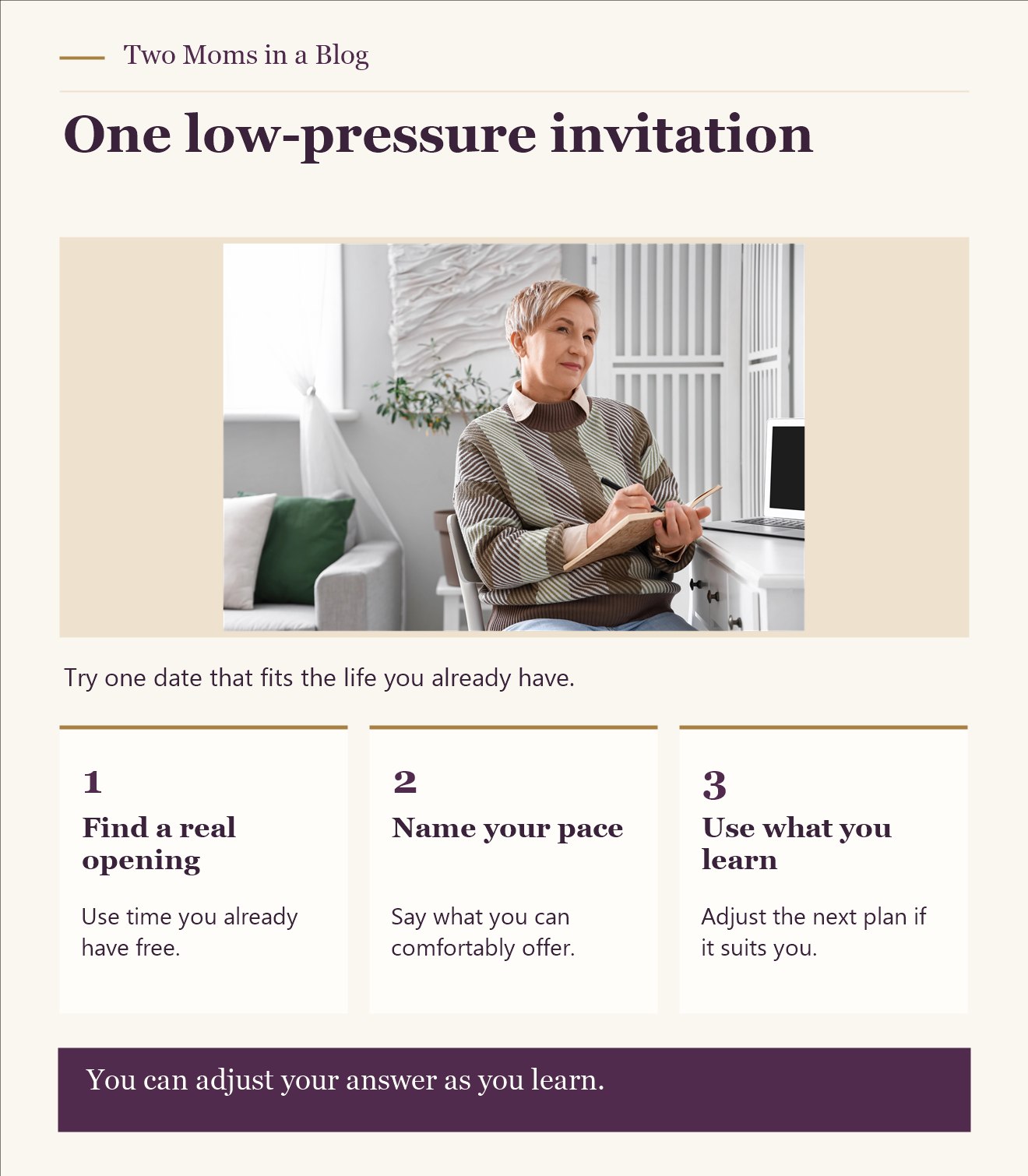
One low-pressure invitation
Try one date that fits the life you already have.
- Find a real opening Use time you already have free.
- Name your pace Say what you can comfortably offer.
- Use what you learn Adjust the next plan if it suits you.
You can adjust your answer as you learn.
Read the guide as text
- Do I want this?. Separate curiosity about a person from pressure to prove you have moved on.
- Do I have capacity?. Consider time, care responsibilities, money, energy and other support.
- Can I choose freely?. Keep room for boundaries, uncertainty and either person’s no.
- What can I try?. Choose a manageable conversation or meeting, then review how it felt.
Asking the Right Questions
Find out what you desire; look at capacity and choice. Desire asks if you want to meet someone, but capacity asks what you can give without giving up your responsibilities or recovery. Choice allows you to know if you can say yes or no without feeling that your future depends on a certain opportunity.
You might desire something but have little capacity during a demanding move or custody change. You might have capacity but have no interest at the moment. You might want companionship but still feel too vulnerable to disagree with a date. Each of these suggests a different next step that you should take.
Write down something about yourself, such as "I'm curious about meeting new people," or "I can go out one evening every other week." This allows you to have a realistic starting point if you're thinking about dating.
Look at these answers as ideas. They describe your circumstances today and don't describe your value or your complete readiness. Look at them when your life changes instead of checking them every evening you feel lonely.
Think About What You Want from Dating Again
Dating after a divorce can mean different things to different people. Maybe you're looking for someone to talk to, enjoy spending time with, share affection with, or eventually build a serious relationship. But problems can come up when you expect someone new to provide all the happiness, reassurance, or emotional healing that you've been missing since your marriage ended.
Before getting back into dating, ask yourself what would make a first date enjoyable, even if it didn't lead to another one. For example, if your answer is something like, "I'd enjoy meeting someone new and having a good conversation," you're giving yourself a chance to enjoy the experience without putting too much pressure on it. But if you're hoping that someone showing interest will prove you're still lovable or that your divorce was the right decision, you might need more emotional support while you're getting back into dating.
There's nothing wrong with wanting to feel appreciated or reassured, especially after going through a difficult divorce. But it's important not to depend on someone you've just met to make you feel better about yourself. Having friends, family members, or other people you can turn to can help you feel connected without expecting a new romantic relationship to meet every emotional need.
You might start making plans to spend more time with friends before signing up for a dating app. Something as simple as taking a weekly walk together, going out for coffee, or enjoying a favorite activity can remind you that companionship doesn't have to come only from dating.
Having a good support system can also make it easier to recognize when someone isn't right for you. Instead of staying interested just because they give you attention, you can focus on whether they treat you with kindness, respect, and genuine interest.
Understand How Your Past Marriage Affects You
Just because your marriage has ended doesn't mean all your feelings about it will disappear. You might still experience sadness, anger, relief, or even affection for your former spouse. Sometimes you might feel several of these emotions in the same day, and that's completely normal. What matters is whether you're able to get to know someone new without constantly comparing them to your former partner.
Think about how comfortable you feel discussing your marriage. Can you talk about your divorce without spending the entire first date explaining everything your ex did wrong? Can you notice something that reminds you of your former spouse without immediately assuming the new person will behave the same way? And can you recognize things you've learned from your marriage without blaming yourself for choices that weren't yours to make?
These questions aren't meant to make you feel like you have to forgive your ex or forget everything that happened. They're simply ways to understand how your past experiences might influence your feelings about dating again. If your marriage involved abuse or controlling behavior, talking with a professional who understands those experiences might help you recognize what feels safe and healthy as you move forward.
For an illustrative example, imagine Rachel has recently started dating again after her divorce. She's enjoying dinner with someone new when he orders the same meal her former husband always ordered. For a second, she's reminded of her marriage and some of the difficult feelings connected to it.
Instead of just thinking that this new person will be anything like her ex, Rachel reminds herself that they're two different people. She continues enjoying their conversation and gives herself a chance to get to know him for who he actually is.
The important thing is remembering that having memories of your former marriage doesn't mean you're not ready to date. But being able to recognize those feelings without letting them control every new experience can help you build healthier connections as you move forward.
Allowing for a No Answer
Dating could include delayed replies, mismatches of interest, and strange moments or endings that can be disappointing without being cruel. Readiness doesn't mean these experiences can stop hurting you, but it means you have ways to respond to them that don't depend on you chasing them, punishing yourself, or abandoning your boundaries.
If you send someone a message and get a polite decline, what are you going to do that evening instead, or who could you call?

If the reaction you have to that example feels overwhelming, then you need to have lower pressure contact. Take a class, join a community event, or have a talk with a friend, which can give you practice without putting romance at stake.
You can respond by saying, "Thanks for being clear. I enjoyed meeting you, and I hope that you have a good life." These words can help reduce the sense that every dating outcome needs to be an emotional emergency.
Create Boundaries Before Chemistry
You should take time to write down a few boundaries around your time, money, physical affection, and communication. Keep the boundaries specific enough so that the person will understand. Just saying "I want respect" is good, but saying something like "I'll leave if someone pressures me to drink more than I want" is easier to take action on.
Notice the difference in your limits. Wanting a partner who enjoys hiking is a preference; being free to refuse sexual contact is a matter of consent. Preferences can be talked about, and it's your right to refuse touch or to end a date without explaining yourself.
Love is respect explains how personal boundaries support healthy relationships. Boundaries can change, but change should reflect your choice rather than pressure.
Try to have a small conversation, such as, "This evening doesn't work for me." Pay attention to their response. If the person accepts your limit, that is way better than someone who argues, sulks, or tries to treat it as a challenge to overcome.
Make Sure Dating Fits into Your Everyday Life
Just because you're excited about dating again doesn't mean you suddenly have more time, money, or energy to spend on a new relationship. Before making plans, think about how much time and money you can realistically put toward dating without making your everyday responsibilities more difficult. Sometimes meeting someone for a quick cup of coffee makes more sense than planning an expensive dinner that takes up your entire evening.
It's also important to think about how dating might affect the rest of your routine. For example, if staying out late leaves you exhausted the next day, you might prefer meeting someone for lunch or spending a little time together in the afternoon. If you notice that constantly checking messages on a dating app is distracting you from work or other responsibilities, try setting aside certain times of the day to check your messages instead of feeling like you have to be available all the time.
Remember that you don't have to explain every detail of your schedule or personal responsibilities to someone you've just met. Saying something simple like, "I'm free Saturday afternoon," should be enough. If someone expects you to be available more often than you're comfortable with, it might just mean that your schedules or expectations aren't a good match.
You also shouldn't feel like you have to prove that you're spontaneous or willing to drop everything just because you're interested in someone. Being dependable, making plans, and respecting commitments are all positive qualities. The right person should understand that you already have a life with responsibilities and interests that matter to you.
Getting back into dating should be something you enjoy instead of another source of stress. A healthy relationship should have room for both people to maintain their routines while gradually finding ways to spend more time together.
Keep Children Safe During Dating
If you have children, being ready to date and being ready to introduce your children are two separate decisions. You can meet other adults privately without asking your child to approve of your romantic future. You can also decide to delay introducing them until you understand the connection better.
The American Academy of Pediatrics offers guidance on helping children adjust to divorce. Its advice includes keeping children out of adult conflict and avoiding the role of messenger.
Building a dating plan around dependent care and privacy means not asking your children to keep secrets from the other parent or to give emotional reassurance about your dates. A child can have feelings about the changes without being responsible for the decision that you make.
There's no universal rule that gives a deadline that works for every family. Look at the child's adjustment, the stability of the relationship, safety, and any important parenting arrangements. A good family professional can help when these things are hard to balance.
Starting Small
You don't have to tell everyone you're dating again, but pick one experiment you can do, such as updating your profile, having a short call, or accepting an invite for coffee.
Before the date, decide what you want to learn. Maybe you want to know if you enjoy talking to someone new or if you are able to talk about boundaries. These are more useful goals than looking for instant approval.
After the date, ask whether you were able to be yourself, if you respected the other person's limits, and what you would change. A small experiment might tell you to pause, and you might find that slower communication is more valuable for you. The purpose is to get more information, not to force yourself to go through a bunch of dates to prove that you're progressing.
Discomfort Vs. Danger
Just because you're nervous before a date doesn't mean you're unsafe. Of course, things like pressure, threats, deception, sexual coercion, or attempts to isolate you need a different response. Don't treat every uneasy feeling as danger, but don't dismiss warning signs.
When you meet up, pick a public place and take your own transportation when you can. Tell someone you trust about your plan. Keep your financial information and access to your home private until you have a reason to trust the person. You can leave a date without an argument about whether you're being reasonable. You don't have to explain why you choose to end a date early.
If you have an ex who monitors your movements or threatens you, dating may involve additional privacy and safety concerns beyond those involving a new match. Talk to a domestic abuse advocate to help you consider the risks privately. You don't have to feel obligated to confront a controlling person to show your own independence.
Finding a Dating Pace That Works for You
For an illustrative example, imagine Daniel recently went through a divorce and is interested in finding a serious relationship. He genuinely wants to meet someone new, but he doesn't have the time or energy to spend every evening talking or texting. When he first starts dating, he assumes that showing someone he's serious means messaging them throughout the day and making plans as often as possible. Before long, he starts feeling overwhelmed and frustrated instead of enjoying the experience.
Daniel eventually realizes that he needs to approach dating differently. When he starts talking to someone new, he's honest about wanting to take things slowly. He explains that he enjoys getting to know someone but usually has more time to respond to messages in the evening. Instead of filling his weekends with several dates, he makes plans for something simple, like taking a walk or meeting for coffee.
The important thing is that Daniel's interest in finding a relationship hasn't changed. He still wants companionship and a meaningful connection, but he also recognizes that he needs time for himself. By slowing things down, he can focus on whether he actually enjoys spending time with someone instead of worrying about whether he's showing enough excitement or attention.
Your experience might be different. Maybe you need to go on fewer dates, try a different way of meeting people, or spend more time adjusting to life after divorce before getting into a serious relationship. There's nothing wrong with any of those options.
Being ready to date again doesn't mean you have to follow the same routine you had when you were younger or before you got married. Life changes, and so do your priorities, responsibilities, and energy levels. What matters is being honest about what you want and what you're comfortable offering someone new. Dating should fit into the life you're building now instead of making you feel like you have to return to the person you were years ago.
Getting Support
Consider qualified support if fear, grief, sleep problems or ongoing stress concern you. Support doesn't mean that you failed a dating test, and it can help you to make choices with more clarity.
A therapist can help you look at patterns and feelings, and they shouldn't guarantee that a romantic outcome will work in your timeline. Friends and support groups can give you companionship, but their advice might reflect their own experiences.
You might need professional advice about separation agreements, finances, or parenting before you make any changes. Rules are different depending on location, and dating articles can't answer all of your questions.
Pick one area where support would help lessen the pressure, like finding affordable childcare, understanding your budget, or dealing with a painful ending. Improving this area of your life can make your life steadier, even if you don't date soon.
Going to the Next Chapter
If you wonder whether you can enjoy interest without it being a promise, or whether you can pay attention to disappointment without deciding that you're unloved, the answer is yes. You should ask yourself whether adding dating apps is something you want to add to your week, whether a new connection would need to justify your divorce, or whether it would replace your loneliness forever.
It's important to be both hopeful and cautious at the same time because you can enjoy going on a date and still decline a second date with them. You can decide you want to have a partner but still choose to have a month where you're on your own.
The next step can be small enough to reverse and clear enough to show you something new. Pick a step that protects the parts of your life that keep you strong but allows you to experience what you want to see happen next.
Explore your next step after divorce
Choose the question you want to reflect on. Readiness does not come from a fixed waiting period or score.
You can be uncertain, interested, cautious or not ready. These prompts do not set a recovery deadline.
Use the questions and examples in the article above; the draft builder needs JavaScript.
15 questions readers ask
1. How long should I wait after divorce to date?
There is no universal waiting period that establishes readiness. Consider your interest, practical capacity, boundaries and support instead of relying only on time.
2. Must I feel completely healed?
You do not need perfect certainty or an absence of sadness. Notice whether you can meet someone as a separate person while attending to your own needs.
3. Can grief and interest coexist?
Yes. Mixed feelings do not automatically require dating or rule it out. You can choose a small step or a pause based on your circumstances.
4. What if I want companionship but have little time?
Be honest about the time you can offer. A shorter meeting or slower contact may fit better than promising a pace you cannot maintain.
5. How do I know whether I want dating or reassurance?
Ask what you would enjoy even if the meeting led nowhere. If you need proof of worth or of the divorce decision, consider other support alongside dating.
6. Should I tell a first date everything about my divorce?
You can share proportionate, truthful context without recounting every conflict or disclosing private information. You may need other spaces to process the ending.
7. Do memories of my former spouse mean I am unready?
Not necessarily. Notice the reminder without assuming a new person will behave the same way. Seek more support if past experiences feel overwhelming.
8. What boundaries are useful to consider first?
Think about time, spending, communication, privacy and physical contact. A specific limit is easier to act on than a broad wish for respect.
9. How can I respond to a polite no?
Respect the answer and use your own support and routines for disappointment. You do not need to obtain an explanation that removes every hurt feeling.
10. Does dating readiness mean my children should meet someone?
No. Those are separate decisions. Consider children’s adjustment, the relationship’s stability, safety and relevant arrangements before planning introductions.
11. Should children keep my dating life secret?
Do not make them responsible for adult privacy or communication. Keep age-appropriate boundaries and obtain advice if your circumstances involve legal or safety concerns.
12. What is a small first step?
You might update a profile, have a short conversation or accept a simple public meeting. The step should provide information without becoming a test you must finish.
13. Can nervousness be different from danger?
Yes. Nerves alone do not establish danger, while threats, coercion or pressure deserve attention. You can decline or leave without proving that a situation is dangerous.
14. What if a former partner monitors me?
Seek private specialist safety guidance before making changes that could expose plans or location. You do not have to confront someone to demonstrate independence.
15. Can I begin dating and then stop?
Yes. Readiness can change with work, health, parenting or feelings. You can slow down or pause while being considerate and honest with people you have been seeing.